Food Fraud Risk: Why Supplier Fraud Becomes Your Business Crisis
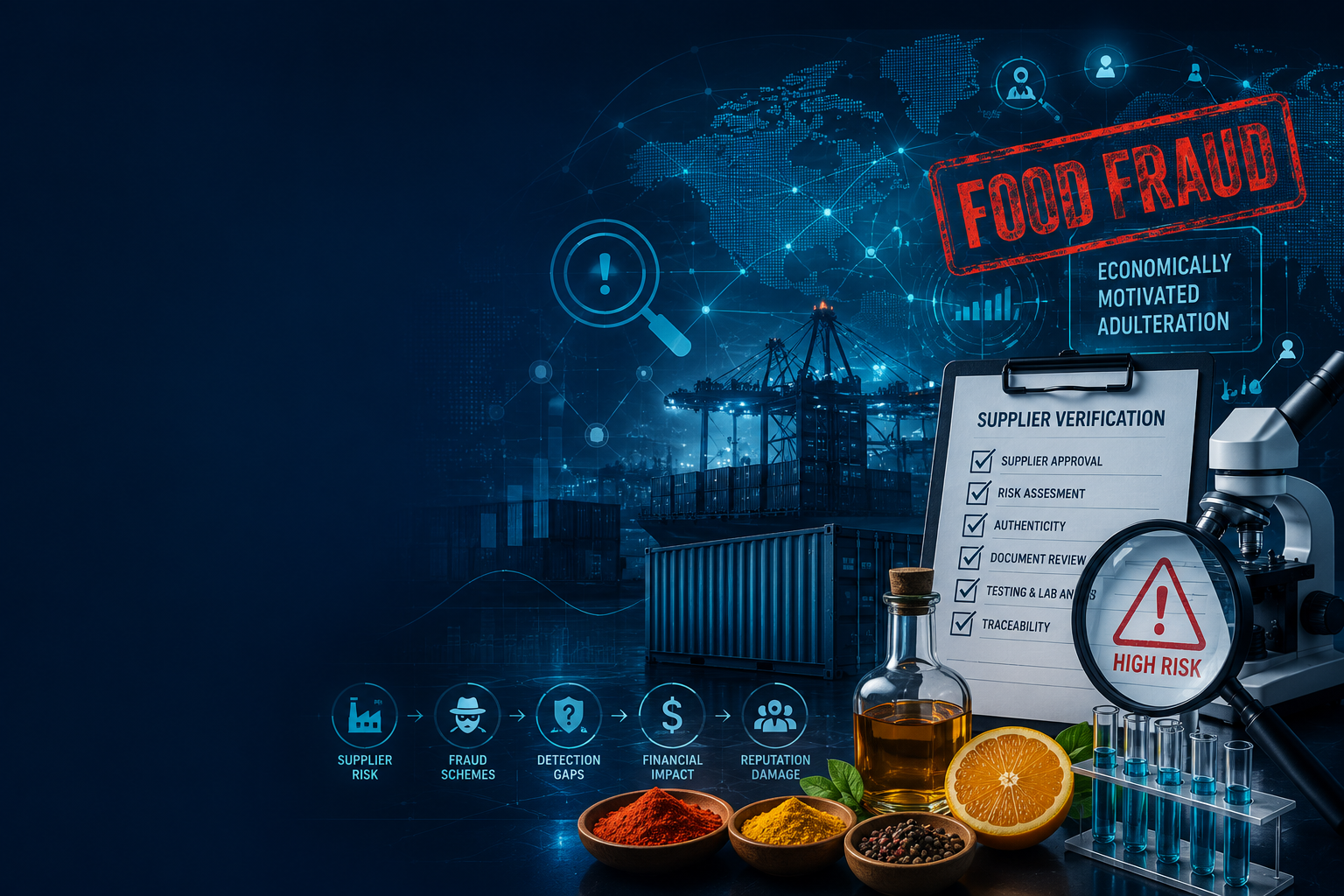
Food fraud is not just "cheating." It can become a public-health incident, a recall, a customer complaint, a regulatory problem, a lawsuit, a social media crisis and a long-term trust failure. When fraud happens upstream, the consequences may still land on your company.
A supplier's fraud can become your recall
Your company may not have added the illegal color. Your team may not have diluted the product. Your facility may not have falsified the COA. Your brand may not have intended to deceive anyone.
But if the product reaches your customer under your name, your supply chain, your import process or your label, the market may not separate the original fraudster from the company selling the product.
A supplier's fraud can become:
- your recall
- your customer complaint
- your border detention
- your allergen incident
- your outbreak investigation
- your retailer delisting
- your social media crisis
- your litigation exposure
- your brand damage
- your explanation to regulators, customers and management
"The fraud may start with your supplier, but the recall, lawsuit, customer loss, and reputation damage can become yours." — Fernando A Lopes
On this page
Jump directly to any topic.
- A supplier's fraud can become your recall
- What is food fraud?
- Why fraud is different
- What FDA expects
- Real business impacts
- Public health risk
- Example: spices
- Example: adulterated alcohol
- Example: orange juice
- Fraud & supplier approval
- Fraud & supplier verification
- Are COAs enough?
- Vulnerability assessment
- Why assessments fail
- Better fraud questions
- Absence of evidence
- Why InspectIQ
- Final conclusion
- FAQ
What is food fraud?
Food fraud is intentional deception involving food for economic gain. It can include adulteration, dilution, substitution, mislabeling, counterfeiting, concealment, false origin claims, document fraud or manipulation of analytical results.
Food fraud is different from ordinary food safety failure because it is intentional. Someone is trying to profit from deception and avoid being detected. That changes the risk logic. The company must consider motive, opportunity, concealment, detectability and consequence.
FDA often uses the term economically motivated adulteration for cases where something is intentionally added, removed, substituted or misrepresented for economic gain.
Why is food fraud different from ordinary food safety failure?
A normal food safety failure may happen because a process drifted, a sanitation control failed or an employee made a mistake. Food fraud is different because the fraudster adapts.
A fraudster may ask:
- What does the buyer value?
- What is expensive to produce honestly?
- What can be diluted, substituted, extended or concealed?
- What test is the customer using?
- What documents does the buyer expect?
- What will nobody test for?
- What will still look normal enough to pass?
That is why food fraud vulnerability assessment must go beyond ordinary hazard analysis. It must consider how deception could happen, why it would be profitable, how it could be hidden and what consequences would follow if it reached the market.
What does FDA expect companies to consider?
From an FDA/FSMA perspective, food companies should not ignore economically motivated adulteration when it could affect food safety.
For facilities subject to the preventive controls rule, hazard analysis must consider known or reasonably foreseeable hazards, including hazards that may be intentionally introduced for economic gain. For U.S. importers under FSVP, supplier and food hazard evaluation can also include hazards intentionally introduced for economic gain.
Food fraud is not only a "quality" discussion. In the right context, it belongs inside food safety, supplier verification, import compliance and risk-based decision-making.
See our related guides on food supplier approval and verification and FDA/FSMA requirements.
What are the real business impacts of food fraud?
Visible costs
- Recall execution
- Product destruction
- Emergency testing
- Supplier investigation
- Legal review
- Customer communication
- Production disruption
- Shipment delays
- Replacement stock
Hidden or long-term costs
- Loss of customer confidence
- Retailer or distributor delisting
- Increased audit pressure
- Regulatory scrutiny
- Import holds or refusals
- Social media amplification
- Litigation
- Insurance consequences
- Brand devaluation
- Management distraction
- Loss of future sales
- Damage to an entire product category or origin
"Is your “100%” product truly 100% what it claims to be?" — Fernando A Lopes
Can food fraud create public health risks?
Yes. Some food fraud causes mainly economic deception, but some fraud can introduce serious public-health hazards.
Examples include:
- Undeclared allergens
- Toxic dyes
- Heavy metals
- Industrial chemicals
- Illegal preservatives
- Unauthorized additives
- Methanol in alcoholic beverages
- Melamine in dairy ingredients
- Unsafe species substitution
- Contamination hidden by falsified documentation
Food fraud can create acute illness, chronic exposure, allergen risk, toxicological concern or even fatal poisoning. It can also be difficult to trace because the harm may be delayed, dispersed, misdiagnosed or never linked back to the fraudulent ingredient.
Example: food fraud in spices
Spices are vulnerable because color, purity, origin and intensity influence value. Fraud may involve substitution, dilution, artificial color enhancement, false origin claims or contamination with unsafe materials.
- Turmeric, chili powder or cumin enhanced with unsafe dyes
- Lead-based or industrial dyes used to intensify color
- Substitution or dilution with cheaper materials
- Fake or recycled COAs
- Supplier documents that do not reflect the actual lot
A spice may represent a small percentage of the final formulation, but it can create a large public-health, regulatory and reputational crisis if adulterated.
Example: adulterated alcoholic beverages
Alcoholic beverages show why fraud severity must be considered, not only fraud frequency. A product may not appear often in a company's fraud database, but if the credible fraud mechanism involves methanol, the consequence can be catastrophic.
Methanol-adulterated alcohol has caused outbreaks worldwide involving blindness, severe poisoning and death, with some incidents reporting more than 60 deaths and others approaching 300 deaths. This is the kind of example that exposes a weakness in many food fraud assessments: they may count known history, but fail to weigh the worst credible consequence. The better question is not only “has this happened often?” but “if fraud occurred here, how bad could it realistically become?”
Example: orange juice, concentrates, pulps and tropical ingredients
Orange juice and tropical ingredients are especially relevant because they connect Brazil, export markets, authenticity, supplier verification, analytical interpretation and technical food fraud evaluation. Have you asked these questions?
A superficial supplier approval process asks
- Price
- Specification
- Shelf life
- Certificate
- COA
- Sample
- Shipping documents
A serious food fraud evaluation asks
- Can your supplier prove that seasonal low °Brix is managed through approved controls, not "undeclared corrections"?
- Could your supplier use lower-grade oranges and compensate with undeclared sugar, flavors, colors or additives?
- Could your supplier use undeclared preservatives to compensate for weak sanitation, GMPs or process controls?
- Could lower-cost juice or by-products be used?
- Could the product be diluted with undeclared water?
- Do you know how to audit food fraud?
- Could pulp wash be added?
Orange juice fraud is not only about whether the product is "real juice." It is about whether the supplier's controls, records, testing strategy and commercial incentives are strong enough to protect the buyer. See our approach to qualifying Brazilian food suppliers.
Why is food fraud relevant to supplier approval?
Food fraud is relevant to supplier approval because many fraud risks begin upstream, before the product reaches the importer, manufacturer or brand owner.
A supplier approval decision should not ask only: "Can this supplier deliver the product?"
It should ask: "Can this supplier deliver the product honestly, consistently, safely, legally and with evidence?"
Supplier fraud review should consider:
- Commodity fraud history
- Economic incentives
- Price pressure
- Supply shortages
- Origin claims
- Organic or premium claims
- Unusual analytical markers
- Supplier transparency
- COA reliability
- Laboratory competence
- Traceability
- Broker or trader involvement
- Change management
- Regulatory history
- Customer complaints
- Corrective action behavior
- Ability to explain technical issues
Why is food fraud relevant to supplier verification?
Supplier approval is the decision to use the supplier. Supplier verification is how the company continues proving that the supplier remains acceptable.
Food fraud verification may include:
- Authenticity testing
- Targeted analytical methods
- Supplier audits
- Mass-balance review
- Traceability review
- COA verification
- Review of laboratory methods
- Review of unusual trends
- Review of price anomalies
- Supplier regulatory screening
- Verification of the actual manufacturing site
- Review of origin documentation
- Review of corrective actions after suspicious findings
- Independent sampling where justified
Generic testing is not enough. Testing should be connected to the fraud mechanism.
Is a certificate or COA enough to control food fraud risk?
No. Certificates and COAs can support a food fraud control program, but they do not replace supplier understanding, vulnerability assessment, targeted verification and scientific interpretation.
A COA can be weak if:
- It is not lot-specific
- It reports only generic pass/fail results
- It does not test the relevant fraud marker
- It uses a method that cannot detect the likely adulterant
- It comes only from the supplier without independent verification
- It is recycled or disconnected from the shipment
- It does not match the product specification
- It ignores measurement uncertainty or method limitations
- It is not reviewed by someone who understands the analytical meaning
"How many companies hit by food fraud believed they had “trusted suppliers” — until the crisis proved trust was not a control?"— Fernando A Lopes
What is a food fraud vulnerability assessment?
A food fraud vulnerability assessment is a structured process used to identify where a company may be exposed to intentional deception for economic gain.
It is not supposed to prove that fraud is currently happening. Its job is to identify where fraud would be attractive, feasible, hard to detect and potentially severe.
A strong vulnerability assessment should consider:
- Product value
- Fraud history
- Economic pressure
- Supply shortage
- Origin and country signals
- Supplier transparency
- Supply-chain complexity
- Detectability
- Testing limitations
- Public health severity
- Commercial impact
- Supplier control
- Substitution or dilution opportunity
- Concealment methods
- Mitigation strength
Why do food fraud vulnerability assessments fail?
Many assessments fail because they look professional but are not decision-grade.
Common weaknesses:
- Confusing "no known fraud" with "low vulnerability"
- Over-relying on databases of known incidents
- Treating supplier trust as a control
- Assuming certification eliminates fraud risk
- Using generic scoring without understanding the fraud mechanism
- Testing frequently but for the wrong adulterant
- Failing to consider severity
- Ignoring how the fraudster would profit
- Not distinguishing fraud drivers from controls
- Not challenging COA reliability
- Using the same depth of assessment for every ingredient
- Failing to update the assessment when market conditions change
"A useful assessment should make the company see risk more clearly, not simply feel more comfortable."— Fernando A Lopes
Better food fraud questions for supplier approval and verification
Product and fraud mechanism
- What makes this product valuable?
- What is expensive to produce honestly?
- What could be diluted, substituted, extended or concealed?
- What would still look normal?
- What would the fraudster gain?
Supplier and supply chain
- Who actually manufactures the product?
- Is there a broker or trader between us and the factory?
- Does the supplier control raw material origin?
- Can the supplier provide traceability?
- Are there unexplained price advantages?
- Has the supplier changed sources, formulation or process?
Testing and COAs
- What does the COA actually prove?
- What does it fail to prove?
- Is the method suitable for the likely fraud?
- Is the result lot-specific?
- Is independent testing needed?
- Are trends reviewed over time?
Public health and business consequence
- Could this fraud introduce allergens?
- Could it introduce toxic chemicals?
- Could it create chronic exposure?
- Could it trigger a recall?
- Could it damage a premium claim?
- Could it become a social media crisis?
- Could it affect an entire category or origin?
Absence of evidence is not evidence of absence
A common mistake is assuming that if a product has little fraud history, the product is low risk.
Food fraud data are incomplete because fraud is hidden, underreported, unevenly detected and often discovered only when someone tests the right thing at the right time.
Known history should be one input, not the whole assessment. Ask:
- Is there an incentive?
- Is there an opportunity?
- Is there a method?
- Is there concealment?
- Is there weak visibility?
- Is the consequence severe?
Food fraud expertise matters when supplier decisions carry risk
Food fraud is one of the areas where InspectIQ's background is especially relevant.
Fernando Lopes has worked with food fraud from academic, regulatory and inspection perspectives. His Master's degree thesis focused on food fraud, including analysis of one of the most comprehensive food fraud databases available at the time. He also has experience detecting fraud indicators during official inspections, interpreting laboratory and authenticity evidence, and connecting food fraud risk with supplier approval, regulatory expectations and business consequences.
Food fraud is not only a laboratory issue. It requires understanding food science, supplier behavior, fraud incentives, analytical limitations, regulatory consequences, inspection logic, documentation, international trade and business risk.
Food fraud risk should be managed before the crisis
Food fraud is not only a consumer deception issue. It can affect public health, regulatory exposure, imports, recalls, litigation, customer relationships, brand trust, social media reputation and long-term commercial value.
A strong company does not wait for fraud to be proven after the damage is done. It asks earlier:
- 1What could be fraudulently changed in this product?
- 2Why would someone do it?
- 3How would they hide it?
- 4Would our supplier controls detect it?
- 5What would happen if we were wrong?
- 6Can we defend this supplier decision with evidence?
Need an independent view of food fraud risk in your supply chain?
InspectIQ helps food companies and importers evaluate supplier fraud risk, food authenticity concerns, COA reliability, documentation gaps, vulnerability assessments and supplier verification — especially for companies sourcing from Brazil or preparing for international market expectations.
Frequently asked questions
What is food fraud?
Food fraud is intentional deception involving food for economic gain. It can include dilution, substitution, adulteration, mislabeling, false origin claims, counterfeiting, document fraud or concealment.
Is food fraud a food safety issue?
It can be. Some food fraud causes mainly economic harm, but some fraud can introduce allergens, toxic chemicals, heavy metals, illegal additives, methanol, melamine or other public-health hazards.
Why does food fraud matter for supplier approval?
Food fraud often begins upstream. A supplier may provide a product that looks acceptable commercially but carries authenticity, safety, documentation or regulatory risks. Supplier approval should include fraud vulnerability, not only price and certificates.
Is a COA enough to prevent food fraud?
No. A COA is useful only if it is lot-specific, technically meaningful, linked to the correct hazard or fraud marker, based on suitable methods and reviewed by someone who understands the result.
What is a food fraud vulnerability assessment?
It is a structured assessment used to identify where food products, ingredients or suppliers may be vulnerable to intentional deception for economic gain.
Why do food fraud assessments fail?
They may fail when they over-rely on known history, supplier trust, certificates, generic scoring or routine testing without understanding the actual fraud mechanism, detectability and consequence.
What are examples of food fraud risks in orange juice?
Possible concerns include dilution with undeclared water, undeclared sugar addition, unauthorized colors, flavors or preservatives, use of lower-value juice or by-products, authenticity marker manipulation and weak control of raw material origin.
Can food fraud damage reputation even without illness?
Yes. Even when public-health impact is limited, fraud can create recalls, lawsuits, retailer pressure, social media attention, loss of consumer trust and damage to an entire product category.
Official references
- FDA — Economically Motivated Adulteration (Food Fraud)
- FDA — FSMA Preventive Controls for Human Food
- FDA — Foreign Supplier Verification Programs (FSVP)
- GFSI — Food Fraud Technical Guidance
- WHO — Food Safety
InspectIQ provides independent technical and regulatory support. This page is for informational purposes only and does not replace legal advice, certification bodies, accredited laboratories, official regulatory decisions or the company's own regulatory responsibilities.